AI in L1/L2 Support: How Many Tickets Can Be Closed Without Humans
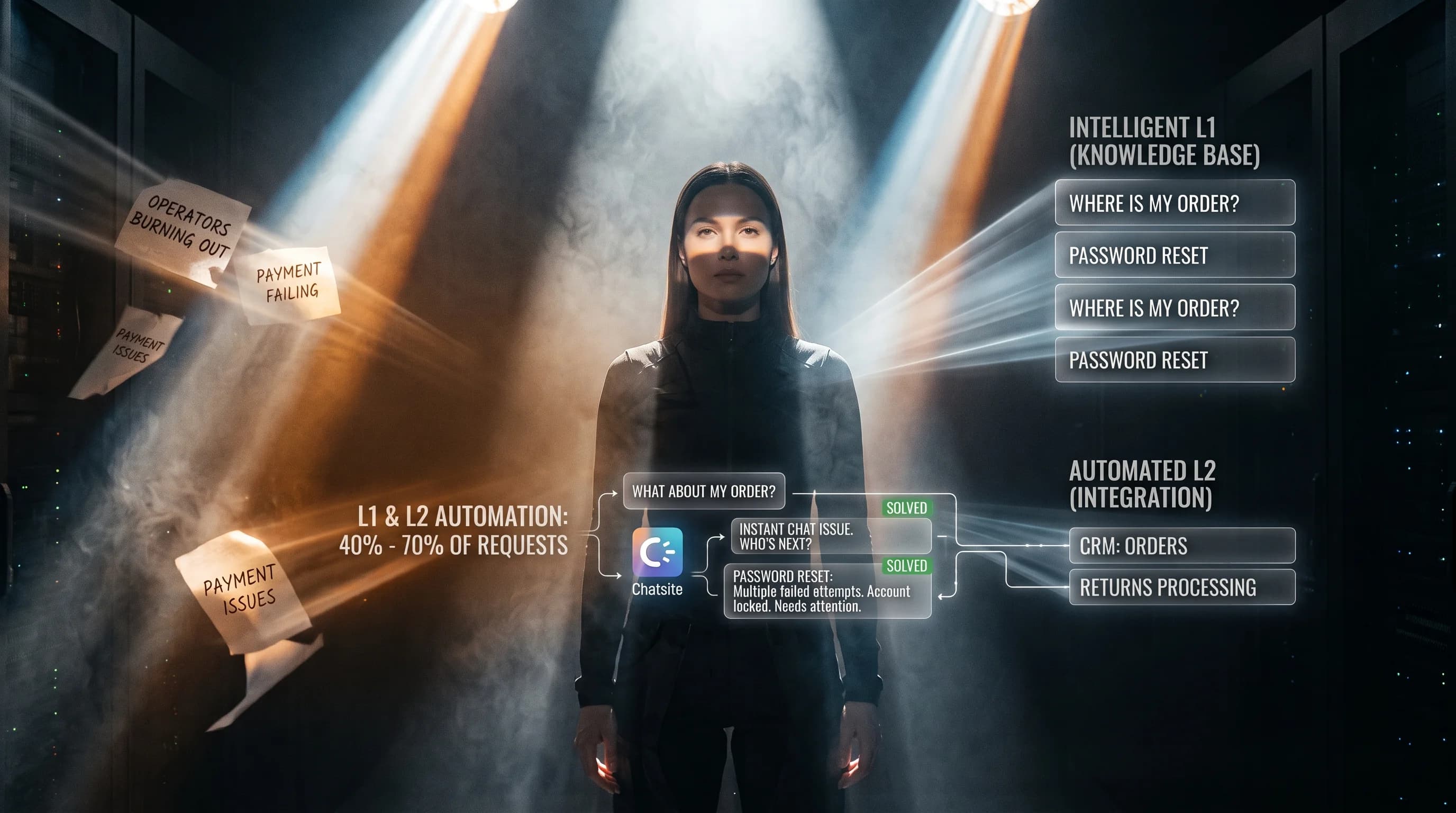
Every day, customer support teams deal with hundreds of repetitive questions: "where is my order?", "how do I reset my password?", or "why did my payment fail?". First-line (L1) operators spend hours copying and pasting template responses, leading to quick burnout, while customers are left waiting in queues during peak hours.
Deploying a digital employee completely changes this dynamic. A modern AI agent can handle not only chat routing but also fully resolve customer problems without any human intervention.
What is L1 and L2 Support in the Context of AI?
In a traditional call center or support desk, the first line (L1) gathers basic information and replies using pre-written scripts. The second line (L2) deals with technically complex cases that require accessing databases and internal company systems.
AI agents on the Plantat1on platform can effectively cover both of these tiers:
- Intelligent L1: The AI analyzes the intent of the question, instantly reads the context, and provides an accurate answer based on your knowledge base (documents, policies, manuals).
- Automated L2: Thanks to deep integration with company systems (e.g., via built-in webhooks and n8n), the AI agent can independently check order statuses in your CRM, cancel bookings, or process refund requests.
How Many Requests Can Be Closed Automatically?
Based on our implementation experience, between 40% and 70% of all incoming requests are standard and can be resolved entirely autonomously, without involving a live operator.
Here is how complete sales and support automation with AI works in practice:
- A client writes in the website chat, Telegram, or WhatsApp.
- The AI agent instantly (in 2-3 seconds) picks up the conversation and resolves the issue.
- If the request is too complex, non-standard, or the client explicitly asks for a human — the agent seamlessly transfers the chat to the right specialist. The entire conversation history is preserved.
This is fundamentally different from classic button-based chatbots, which run on rigid algorithms and often only frustrate customers with dead ends.
Reducing Workload and Calculating ROI
The main argument for implementing AI is transparent mathematics. You are not just cutting response times from 15 minutes to 2 seconds; you are directly reducing payroll expenses. Operators stop working as answering machines and can focus on complex cases and retaining high-value clients.
The SWAS (Software Working As a Service) approach means you don't need to hire developers for setup. You get a ready-made digital "employee" that learns from your data and gets to work immediately.
Ready to take the routine off your team's shoulders? Install the Chatsite widget on your website and delegate your first line of support to an AI agent.