How an AI Employee Differs from a ChatGPT Subscription: Why Your Business Needs Its Own Neural Network
Ever since ChatGPT became a mainstream tool, many executives have been asking: "Why should we implement a complex AI agent or order custom development if we can just buy a ChatGPT Plus subscription for $20 a month for our managers?"
At first glance, there seems to be no difference—a powerful language model works in both cases. But in practice, attempting to automate business processes through the public ChatGPT interface often results in failure. In this article, we will break down why modern AI agents fundamentally differ from public chatbots and why companies need their own integrated neural network.
Problem #1. Lack of Context and Memory
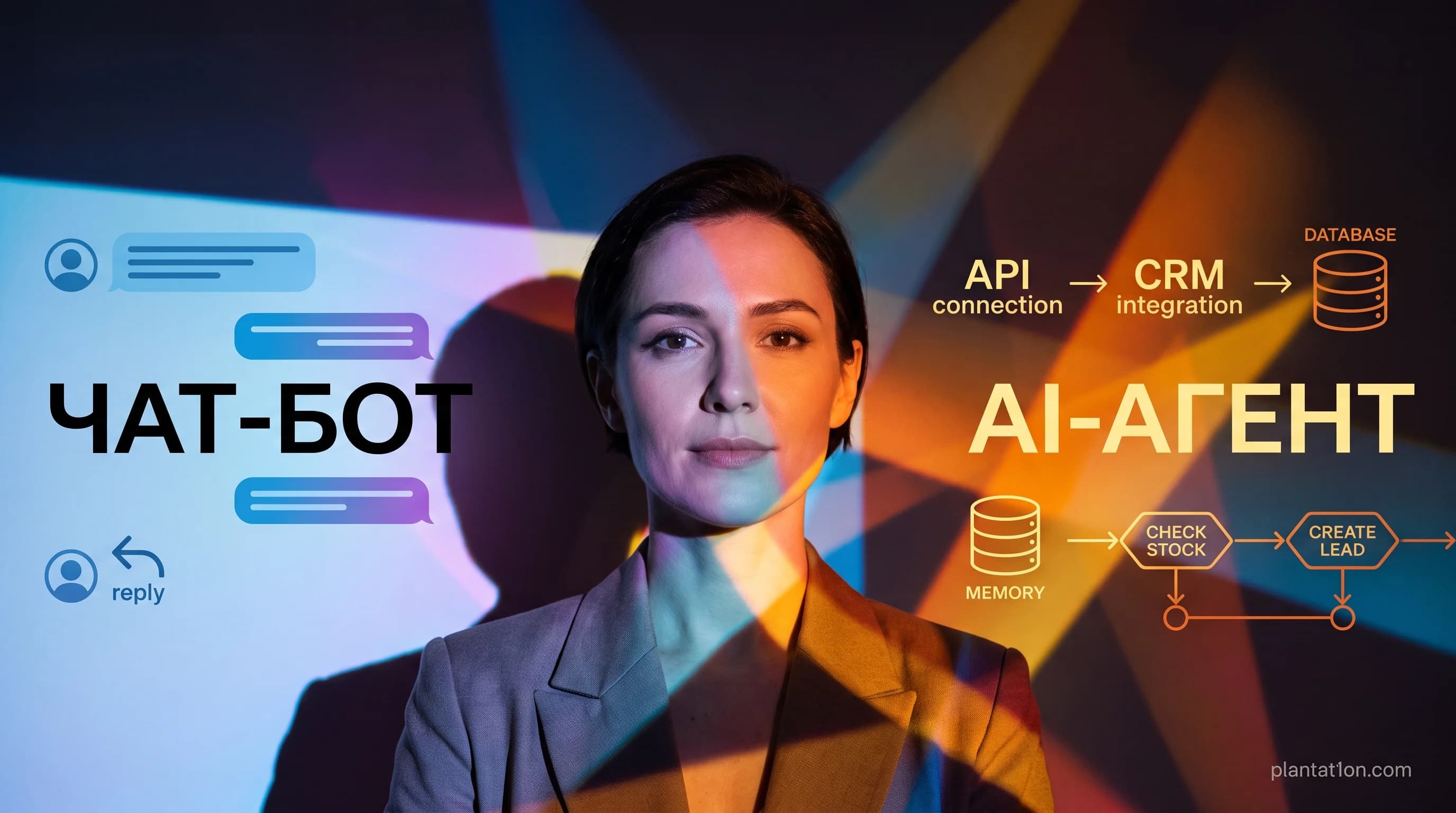
ChatGPT is a brilliant polymath with amnesia. Every time your employee opens a new dialogue, the neural network knows nothing about your company. To get a quality answer, the manager has to write long prompts (instructions), explaining: "We are such-and-such company, we sell these products, our target audience is this, answer in this style."
An AI employee (Agent) has long-term memory. Upon implementation, the company's knowledge base is loaded into its architecture (RAG technology). It already knows your policies, product catalog, sales scripts, and Tone of Voice. You don't need to explain anything to the agent: when a client asks about shipping costs, the AI instantly retrieves the current tariff from your database. We wrote more about how an agent's memory works in our article on the anatomy of a digital employee.
Problem #2. Isolation from Business Processes
ChatGPT works in a sandbox. It can write a beautiful email or come up with ideas for posts, but it cannot do the work for you. If a client asks for their order status, your manager still has to go to the CRM, find the order, copy the status, and paste it into the chat... The neural network hasn't saved a second of time here.
An AI employee is part of your infrastructure. Under the SWAS model, the agent is integrated into your ecosystem via API. If a client asks for an order status, the agent autonomously makes a request to your CRM or ERP, gets the tracking number, and replies to the client directly on the website or in Telegram. It doesn't just generate text—it performs concrete business actions.
Problem #3. Security and Data Leaks
ChatGPT trains on your data. If your employee uploads a financial report or a client database with phone numbers into a public chatbot (to ask it to "make a pivot table"), this data can become part of OpenAI's training set. Tomorrow, your competitor might get this information in response to their own query. This is a serious information security risk.
An AI agent guarantees data isolation. Corporate AI solutions use closed API gateways (Zero Data Retention). Not a single client request or internal document is used to retrain global models. Your corporate data remains strictly within your business's perimeter.
Problem #4. Lack of Control Over "Hallucinations"
Public models tend to fantasize (hallucinate). If ChatGPT doesn't know the answer, it might make one up—for example, promising a client a 90% discount or inventing a non-existent feature of your product. For a business, such mistakes are very costly.
A corporate AI agent has strict system limitations (Guardrails). It is programmed to answer only based on your knowledge base. If the answer is not in the database, the agent will honestly say: "I do not have this information, let me transfer you to a specialist," and will perform a seamless handoff to a live operator.
Conclusion: Tool vs. Employee
A ChatGPT subscription is a great digital typewriter for marketers and copywriters. It helps write texts faster or brainstorm ideas, but it does not replace humans.
A corporate AI agent is an autonomous digital employee. It communicates with clients independently, qualifies leads, enters data into the CRM, and solves client problems 24/7 without human intervention.